
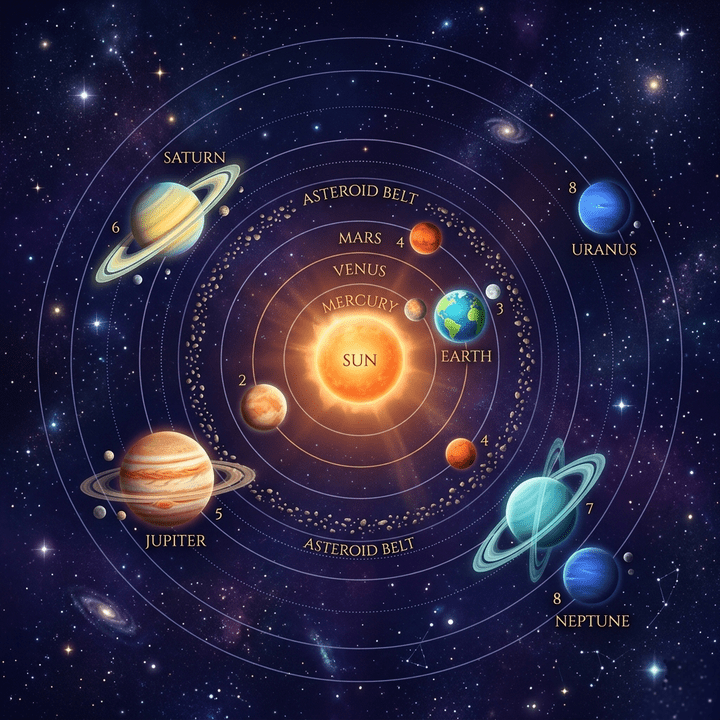
Hey space explorers! Ever look up at the night sky and marvel at the seemingly perfect order of our own solar system? Nine, well, eight beautiful planets, each in its predictable lane, orbiting the sun like clockwork. It’s a cosmic dance we’ve come to understand pretty well, a testament to stability and harmony.
But what if I told you that out there, amongst the stars, there are planetary systems that defy all our expectations of cosmic order? Just recently, astronomers using NASA’s TESS spacecraft discovered something truly mind-boggling: a system named TOI-201. It’s a celestial playground, or perhaps a cosmic mosh pit, with planets moving in ways we’ve never seen before!
Unlike our “peas in a pod” solar system, where planets tend to be somewhat similar, TOI-201 is a real mixed bag. We’re talking a rocky super-Earth six times the mass of our planet, orbiting incredibly fast, right alongside gas giants of wildly different sizes! But here’s the kicker: their orbits aren’t just unique; they’re actually changing so rapidly that astronomers can observe these shifts in almost real-time! It’s like watching a cosmic ballet where the dancers keep changing their steps mid-performance!
So, this begs the huge question: why are some exoplanet systems so incredibly chaotic and different from our own? What forces are at play that cause such dramatic, observable orbital shifts? Does it tell us something new about how planets form, or how they interact over billions of years? Understanding systems like TOI-201 could completely redefine our understanding of planetary evolution, showing us that our solar system might just be one of many, many ways the universe arranges its worlds.
As new telescopes like the Nancy Grace Roman Space Telescope come online, and as we continue to push the boundaries of observation, we’re sure to uncover even more bizarre and wonderful planetary arrangements. Each new discovery brings us closer to answering the fundamental question: how common is our orderly solar system, and what wild cosmic dances are happening far, far away?