
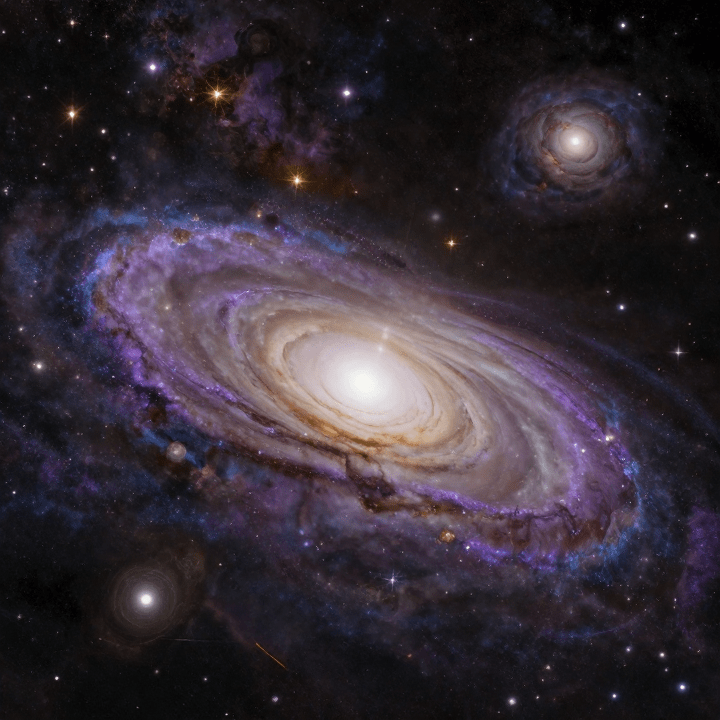
Imagine looking out into the night sky, but instead of just stars, you’re seeing entire galaxies, each with billions of stars, all moving away from each other. Our universe is not static; it’s constantly growing, expanding outwards.
To measure how fast this expansion is happening, scientists use cosmic speedometers. They look at things like distant exploding stars, called supernovae, and the faint afterglow of the Big Bang itself, the cosmic microwave background radiation.
The puzzle is, these different methods don’t agree! Measurements from the early universe suggest one expansion speed, while measurements from our more local, recent universe suggest a different, faster speed. This disagreement is called the ‘Hubble Tension’.
This discrepancy, this ‘tension,’ is incredibly exciting for physicists. It suggests that our current best understanding of the universe, the Standard Model of cosmology, might be missing something crucial.
Could there be new, undiscovered particles, forces, or even dimensions at play? This cosmic puzzle is pushing the boundaries of our knowledge, hinting at profound new physics that could reshape our understanding of everything.