
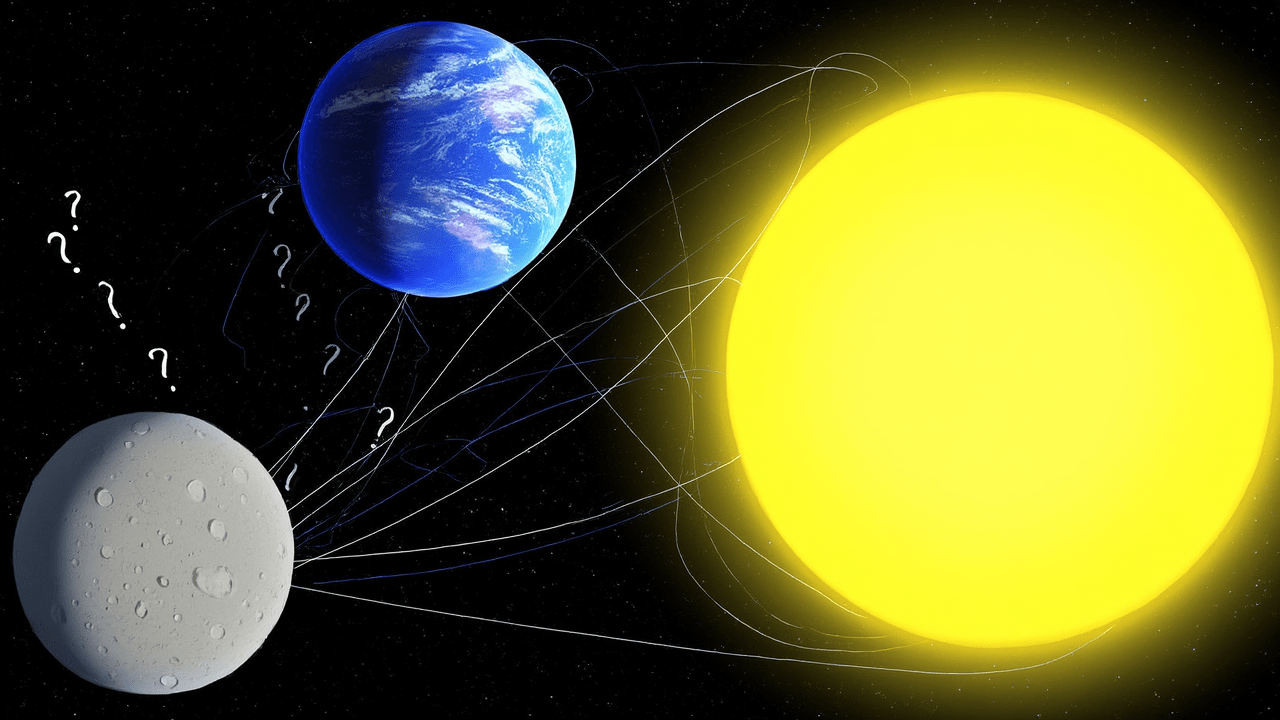
Have you ever wondered why predicting the movement of just three celestial objects in space can be incredibly difficult, almost impossible, compared to just two?
Imagine just two objects, like our Earth gracefully orbiting the Sun; their dance is elegant, predictable, and we can easily calculate their future positions for millions of years.
But now, let’s add just one more object, say, our Moon, and suddenly, everything changes; the gravitational pulls become a chaotic, mind-boggling mess!
This, my friends, is the infamous “Three-Body Problem,” and it’s notoriously difficult because there’s no neat, simple mathematical formula to predict their long-term movements precisely.
Unlike the two-body problem, where gravity gives us elegant, stable ellipses, the three-body system has so many interacting forces that a perfect, general solution simply doesn’t exist.
Scientists use powerful computers to simulate these interactions, making incredibly accurate predictions for short periods, but over long times, tiny errors compound into huge uncertainties.
This challenge affects everything from understanding the stability of distant star systems to planning complex spacecraft trajectories; it’s a fundamental limit to our predictive power in the cosmos.
So, the next time you look up, remember, even with just three objects, the universe reveals its incredible, beautiful, and sometimes, unpredictable complexity.