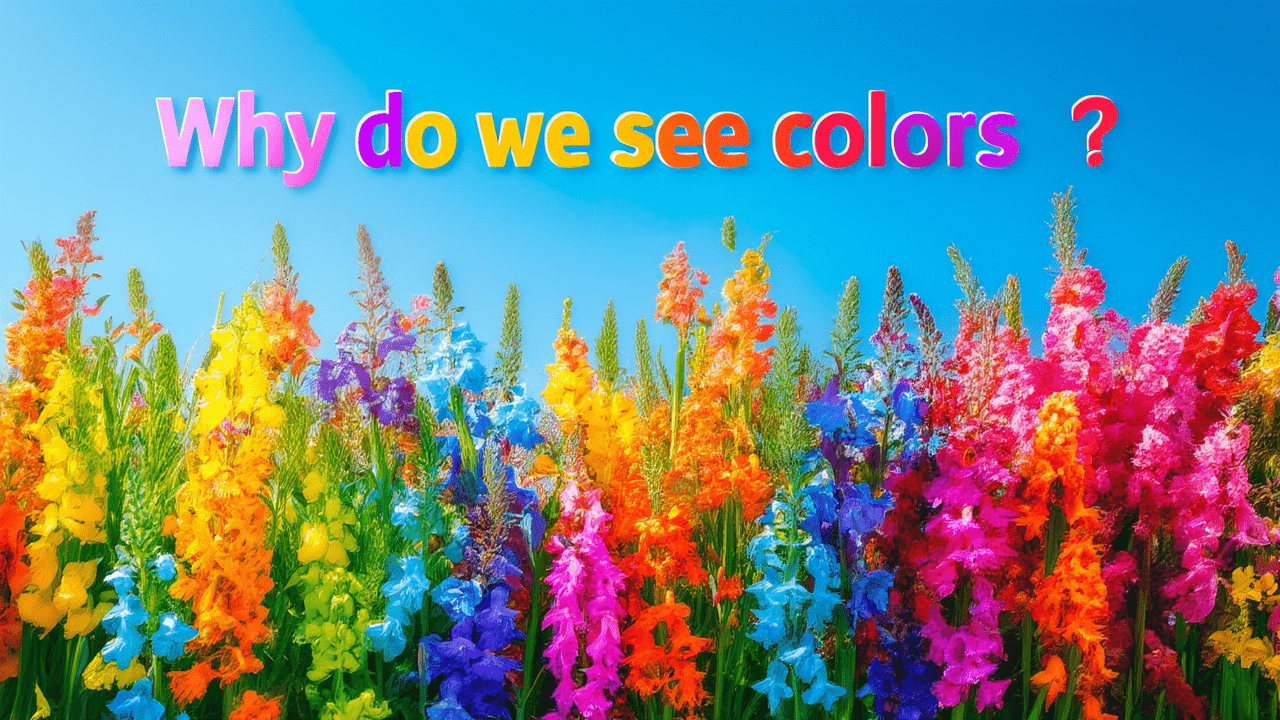
Have you ever stopped to truly appreciate the incredible world of color around us? From the vivid green of a tree to the deep blue of the ocean, colors fill our lives with beauty and meaning. But have you ever wondered, why do our eyes see colors?
Well, it all starts with light. What we call “light” is actually a type of energy that travels in waves, part of something called the electromagnetic spectrum. Sunlight, for example, looks white, but it’s really a mix of all the colors of the rainbow. When this light hits an object, like a bright red apple, the apple’s surface absorbs most of those light waves, but it reflects the red ones. It’s these reflected light waves that reach our eyes!
Once light enters your eye, it travels to a special layer at the very back called the retina. The retina is packed with millions of tiny, light-sensitive cells called photoreceptors. There are two main types: rods and cones. Rods are great for seeing in dim light and detecting shapes, but they only see in shades of gray. They’re why everything looks black and white at night!
But for color, we need the cones! We have about six million cone cells in each eye, concentrated in the central part of our retina. Most people have three types of cones, each primarily sensitive to different wavelengths, or “colors,” of light: one for short wavelengths, which we perceive as blue; another for medium, which is green; and a third for long wavelengths, which is red.
When those reflected light waves from an object hit your retina, they excite these different types of cones to varying degrees. For instance, if you look at something yellow, it activates both your “red” and “green” cones, but not so much the “blue” ones. Our eyes can distinguish millions of different colors because of the unique combinations and strengths of signals from these three cone types.
But here’s the most fascinating part: your eyes are just the messengers! These electrical signals from your cones travel along your optic nerve, all the way to your brain’s visual cortex. It’s your brain that then takes all this raw data—the different levels of activation from your red, green, and blue cones—and combines and interprets it. The brain essentially creates the sensation of color, making sense of those millions of unique signals to paint the vibrant world you see. So, color isn’t “in” the object, it’s a magnificent creation of your brain!
From the light bouncing off surfaces to the specialized cells in your eyes and the complex processing in your brain, seeing colors is a true marvel of biology and physics. It’s a constant, dazzling display, all thanks to this intricate system working in harmony!