
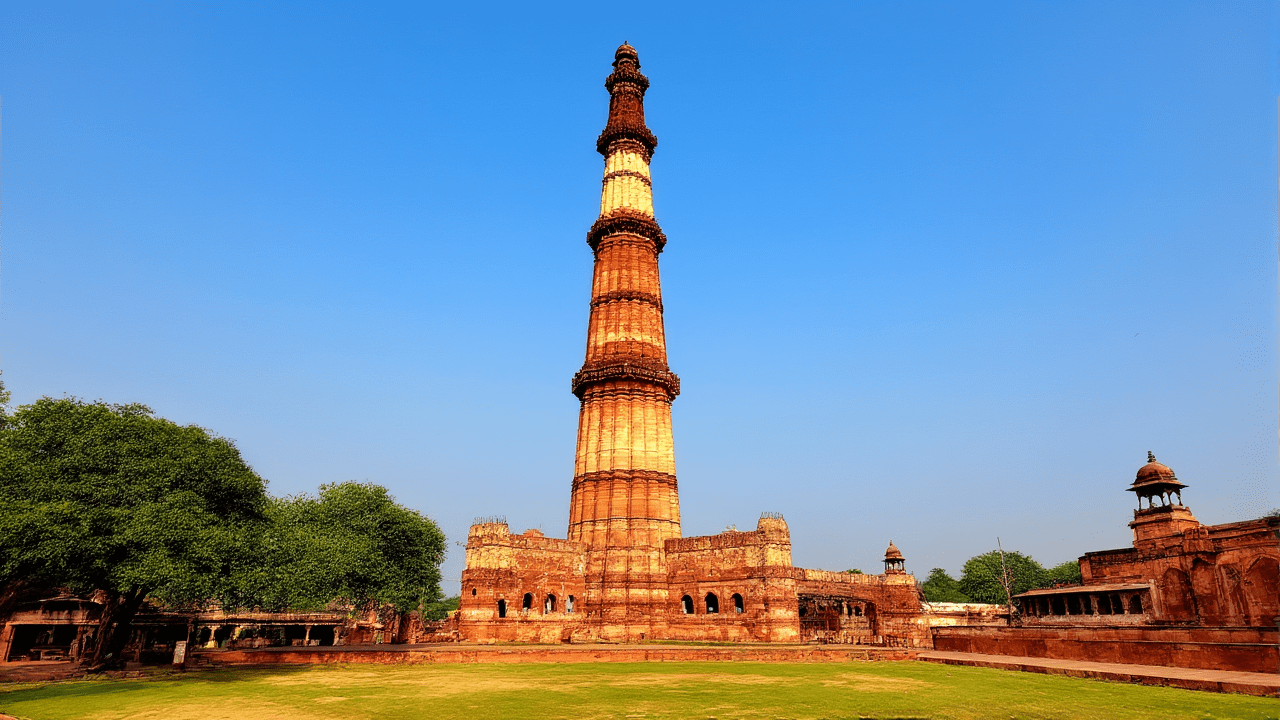
Hey there, history explorers! Have you ever wondered about the stories behind those incredible ancient monuments? Today, we’re taking a virtual trip to Delhi, India, to unravel the mystery of one such marvel: the Qutub Minar!
So, why was this towering structure built? Its construction began way back in 1199 AD by Qutb-ud-din Aibak, the first ruler of the Delhi Sultanate. He started it as a “victory tower” to celebrate Muhammad Ghori’s triumph over the Rajput king, Prithviraj Chauhan, in 1192 AD, marking the beginning of Muslim rule in India. He only managed to complete the first storey before his death.
But Aibak wasn’t the only one involved! His successor, Iltutmish, added three more stories. Later, after a lightning strike damaged the top, Firoz Shah Tughlaq rebuilt the damaged section and added the final two stories, completing the minaret in 1368 AD. That’s why you see a blend of architectural styles!
While it’s famously a “victory tower” symbolizing the establishment of Muslim rule, the Qutub Minar also served other important purposes. It was used as a minaret for the Quwwat-ul-Islam Mosque, the oldest mosque in India, from which the muezzin would call Muslims to prayer. Some historians even suggest it symbolized the new socio-religious system and the declaration of suzerainty over the land.
Standing at 72.5 meters, or about 238 feet, it’s the tallest brick minaret in the world! Its construction used red sandstone and marble, and you can see beautiful carvings and inscriptions from the Quran. It truly is a remarkable blend of Indo-Islamic architecture.
So, the Qutub Minar isn’t just a tall tower; it’s a monumental symbol of historical shifts, architectural brilliance, and the blending of cultures in India. A truly fascinating piece of history, wouldn’t you agree?