
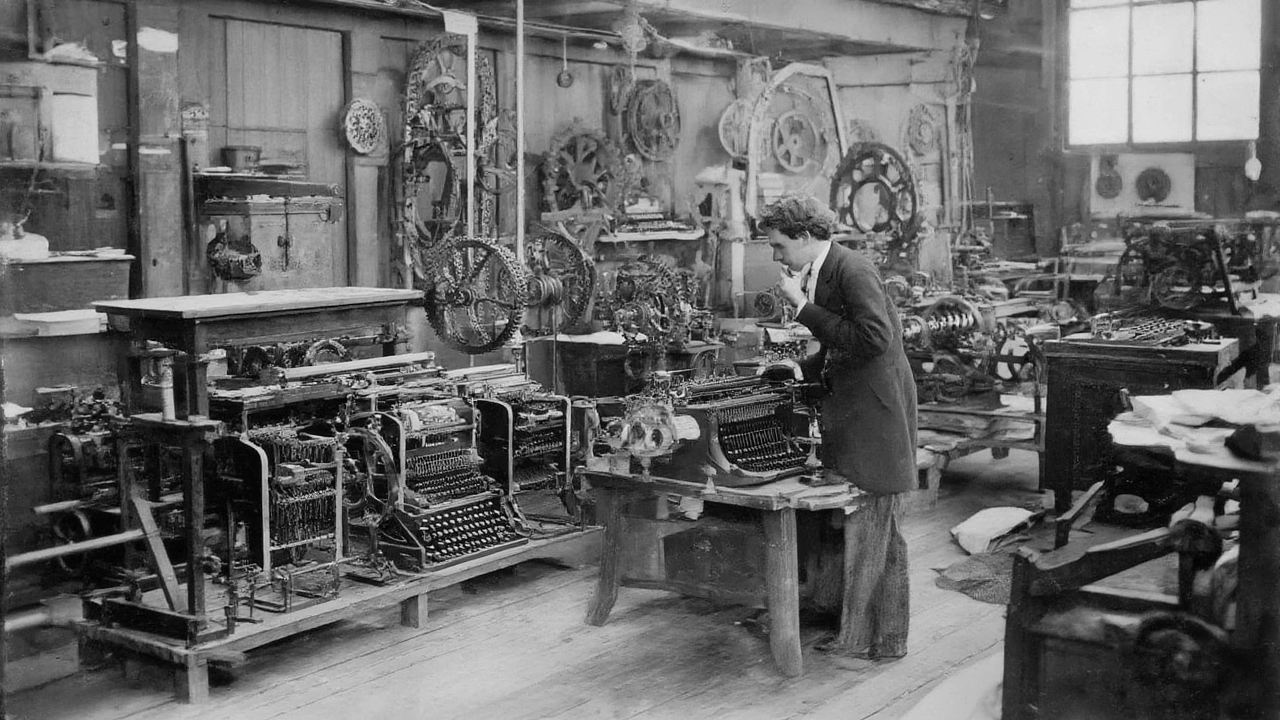
Have you ever looked at your keyboard and wondered, “Why are the letters arranged like that?” It seems a bit random, doesn’t it? Well, the story of the QWERTY keyboard takes us back to the 1800s, to a time when typewriters were revolutionary technology.
Early mechanical typewriters had a big problem: if you typed too fast, especially with common letter combinations, the metal arms holding the letters would crash into each other and jam! Imagine trying to write a letter, and your machine constantly seizing up. Frustrating, right?
Enter Christopher Latham Sholes, a newspaper publisher and inventor. He, along with his colleagues, was working on these early typewriters. To fix the jamming issue, Sholes began experimenting with different key arrangements. The goal? To strategically place commonly used letters farther apart, preventing those mechanical clashes. This innovative approach led to the QWERTY layout, named after the first six keys on the top row.
In 1873, Sholes sold his patent to E. Remington and Sons, a company that later became Remington Arms Company. They started mass-producing typewriters with the QWERTY layout. As these typewriters became more popular, so did the QWERTY design. People learned to type on it, typing classes taught it, and it just became the standard.
Even though modern computers and smartphones don’t have those jamming typebars, the QWERTY layout stuck. It’s a classic example of “path dependency” – once something becomes widely adopted, it’s incredibly hard to change, even if a theoretically more “efficient” layout exists, like Dvorak. So, the next time you type, remember: your QWERTY keyboard is a direct descendant of a clever solution to a very old mechanical problem!