
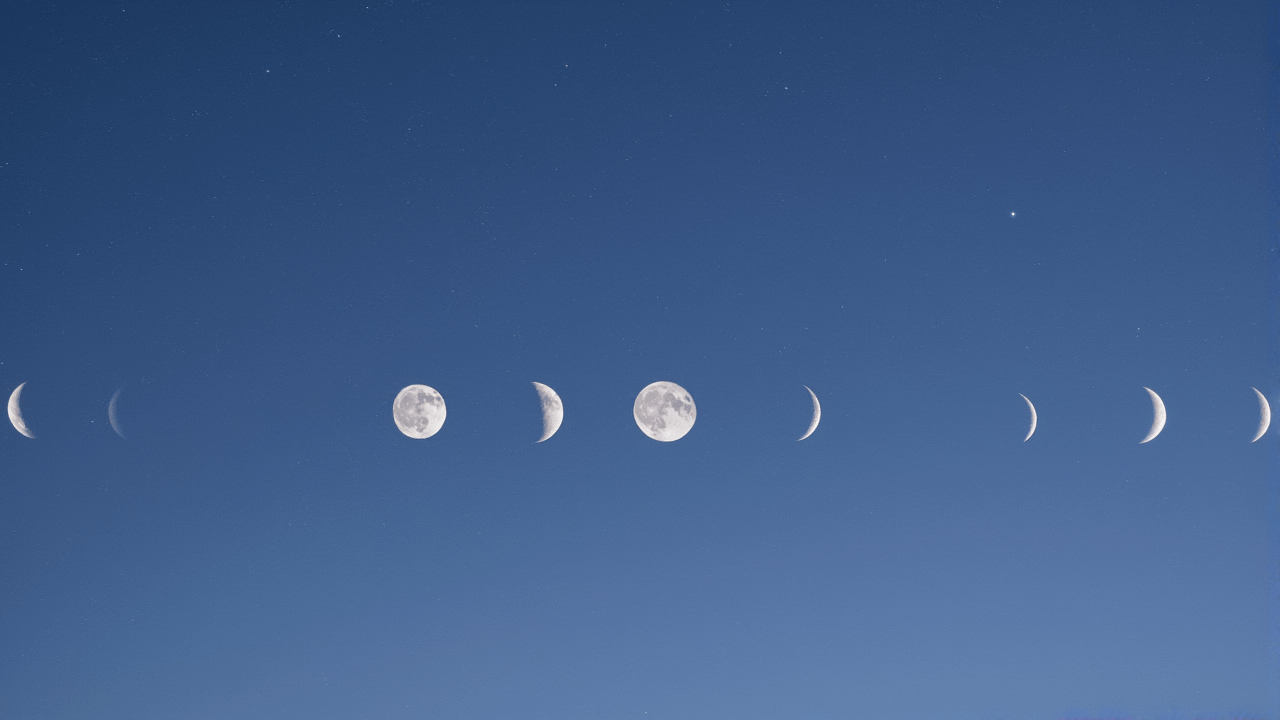
Have you ever looked up at the night sky and noticed that the moon seems to change its shape every night? Sometimes it’s a tiny sliver, other times a perfect circle, and then it disappears completely! These changing appearances are what we call “moon phases.”
Here’s the first crucial thing to understand: the moon doesn’t actually produce its own light. It’s like a giant mirror in space, simply reflecting light from the Sun, just like Earth does. So, one half of the moon is always lit by the Sun, while the other half is always dark.
Now, imagine the moon continuously orbiting around our Earth. This orbit takes about 29.5 days to complete, which is roughly a month. As the moon travels around us, its position relative to the Sun and Earth constantly changes.
Because the moon is orbiting Earth, we on Earth see different amounts of its sunlit side throughout the month. When the moon is between the Sun and Earth, the side facing us is dark, and we call that a “new moon.” As it moves, we start to see a sliver, then a quarter, then half, and eventually, when the Earth is between the Sun and Moon, we see the entire sunlit side—that’s a “full moon!” The cycle then continues as the visible illuminated portion shrinks again.
So, the moon isn’t actually changing shape; we’re just seeing different amounts of its sunlit surface as it orbits our planet. It’s all about perspective! Isn’t that fascinating?