
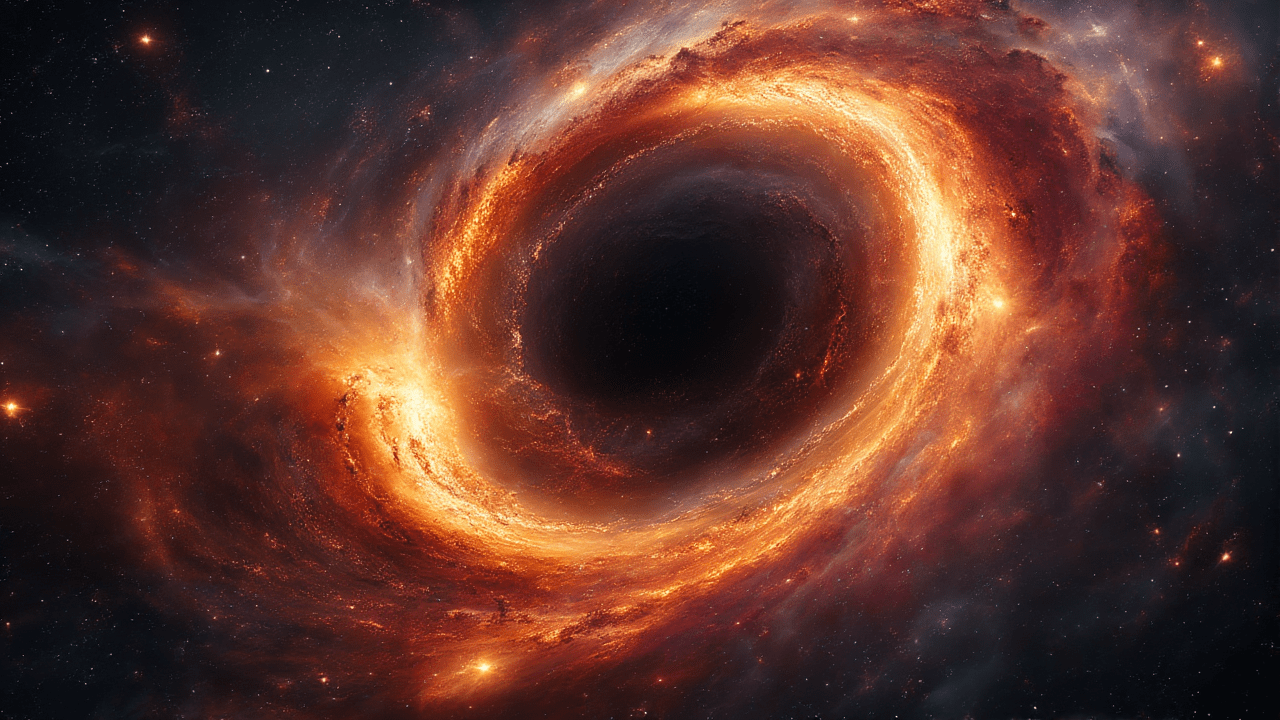
Imagine a cosmic vacuum cleaner, but not one that sucks things up from far away. Instead, picture a region in space where gravity is so incredibly powerful, nothing, not even light, can escape its grasp! This, my friends, is a black hole.
How does this happen? Well, black holes form when a huge amount of matter gets squeezed into an incredibly small space. Think of it like putting the entire Earth into the size of a marble! This extreme compression creates a gravitational pull so intense that it literally warps or bends the fabric of space and time around it.
The boundary around a black hole, beyond which there’s no return, is called the “event horizon.” If anything crosses this line, it’s destined to fall towards the black hole’s center, forever.
Black holes aren’t all the same size. “Stellar” black holes form when very massive stars run out of fuel and collapse in on themselves, often after a spectacular explosion called a supernova. These can be several times the mass of our Sun.
Then there are “supermassive” black holes, which are millions or even billions of times the mass of our Sun! Scientists believe nearly every large galaxy, including our own Milky Way, has one of these behemoths at its very center.
Now, what if you fell into a black hole? Well, you wouldn’t just vanish. Due to the extreme difference in gravity pulling on your feet versus your head, you’d be stretched out like spaghetti! This bizarre phenomenon is actually called “spaghettification.”
Black holes are still one of the universe’s greatest mysteries, constantly pushing the limits of our understanding about space, time, and gravity. They’re not cosmic vacuum cleaners, and they won’t suck in Earth. They’re incredible natural laboratories for physicists, helping us explore the most extreme conditions in the cosmos!